

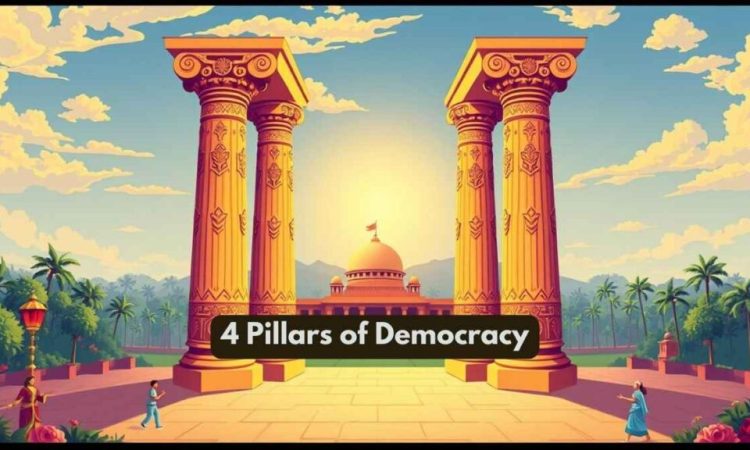
The 4 Pillars of Democracy do not rest on a single idea. They are held up by four foundational principles that work together. Without any one of them, the whole structure weakens. The four pillars are Sovereignty of the People, Rule of Law, Separation of Powers, and Protection of Civil Liberties.
These pillars aren’t abstract theories. They’re the guardrails that protect citizens from abuse of power, ensure fair governance, and give people a meaningful say in how they’re governed. Understanding them isn’t just for political scientists – it’s essential knowledge for every citizen.
At a Glance: The 4 Pillars
Here’s a quick overview before we dive deeper into each one:
| Pillar | Core Role | Real-World Example | Key Threat Today |
| Sovereignty of the People | Citizens hold ultimate power via elections | Universal voting rights | Voter suppression, apathy |
| Rule of Law | Law applies equally to everyone | Impeachment of leaders | Selective enforcement |
| Separation of Powers | Legislature, Executive, Judiciary stay separate | US Constitutional checks | Executive overreach |
| Protection of Civil Liberties | Individual rights protected from state abuse | Free press, free speech laws | Surveillance, censorship |
Pillar 1: Sovereignty of the People
This is the bedrock of democracy. It means that power comes from the people – not from kings, armies, or corporations. Citizens elect representatives, and those representatives are accountable to the people who voted for them.
In practice, this shows up through universal suffrage (the right to vote), free and fair elections, and the ability to remove leaders who fail to serve the public interest.
Why it matters today: Voter suppression, disinformation campaigns, and low civic engagement all erode popular sovereignty. A democracy where people don’t vote – or are prevented from voting – is a democracy in name only.
Pillar 2: Rule of Law
In a democracy, no one is above the law – not the president, not the wealthy, not the military. The rule of law means that laws are applied consistently, publicly, and without favoritism.
This pillar protects ordinary citizens from arbitrary punishment and ensures that leaders face consequences for wrongdoing. Courts must be independent, and laws must be clear and just.
Why it matters today: When laws are selectively enforced – protecting the powerful and punishing the weak – the rule of law breaks down. Judicial independence is under pressure in multiple democracies around the world.
Pillar 3: Separation of Powers
Democracies divide government into branches so that no single entity holds all the power. Typically this means a legislature (makes laws), an executive (enforces laws), and a judiciary (interprets laws).
These branches check and balance each other. If the executive tries to overstep, the legislature or judiciary can push back. This design was specifically built to prevent tyranny.
Why it matters today: When executives try to control courts or bypass legislatures, this pillar is under threat. Checks and balances only work when each branch is willing and able to exercise its authority.
Pillar 4: Protection of Civil Liberties
Democracy protects individual rights – freedom of speech, freedom of religion, the right to a fair trial, freedom from arbitrary detention. These rights exist specifically to limit what the government can do to its citizens.
A free press is often called the “fifth pillar” of democracy precisely because it holds power accountable. Without protected civil liberties, governments can silence dissent and operate without scrutiny.
Why it matters today: Surveillance technology, censorship, and the erosion of press freedom are modern threats to civil liberties. When journalists are jailed and citizens are monitored without cause, democracy suffers.
Why All Four Pillars Must Work Together
Remove one pillar and the others begin to fail. Elections without rule of law become corrupt. Rule of law without civil liberties becomes oppression. Separation of powers without popular sovereignty becomes oligarchy.
The health of a democracy is visible in how well all four pillars are upheld – simultaneously, consistently, and under pressure. That’s why civic education, an engaged public, and independent institutions aren’t just nice to have. They’re essential.